

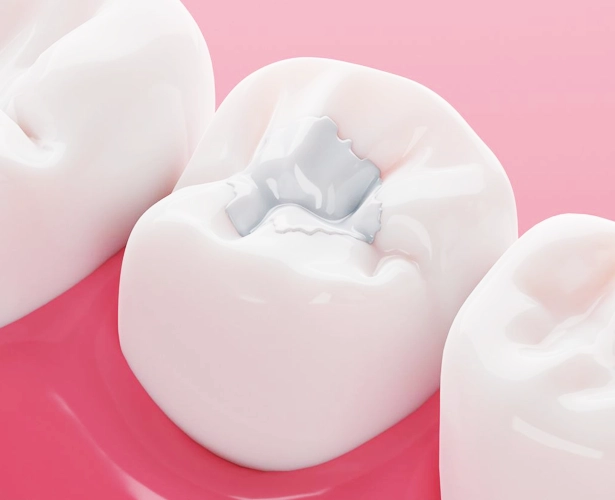
Tooth-Colored Fillings for a Flawless Finish
Traditional silver amalgam fillings can stand out and negatively impact the look of your smile, often making your teeth appear discolored.
If you're seeking a more discreet solution, tooth-colored composite fillings are an excellent choice. Not only do these fillings effectively treat cavities, but they can also be used to reshape chipped teeth or close small gaps, resulting in a more harmonious and visually appealing smile.
What Is a Composite Filling?
Composite fillings are created from a mixture of resins, fillers, and pigments, applied in layers and then hardened through a curing process.
Unlike silver amalgam fillings, composites can be tailored to match the color of your natural teeth, providing a more discreet and visually appealing restoration.
Because they adhere directly to the tooth, composite fillings usually require less removal of healthy dental structure, helping to preserve the tooth’s integrity and strength. Additionally, they offer greater resistance to cracking and chipping from temperature variations in your mouth, making them a more durable option compared to amalgam fillings.
How Are Composite Fillings Applied?
To place a composite filling, the dentist first numbs the area as needed and removes any decay. The tooth is prepared by etching its surface to create a rough texture that helps the composite adhere better. After selecting a shade that matches your natural teeth, the dentist mixes the composite material and applies it in layers, curing each layer as it’s added. Once the layers are built up, the filling is shaped to fit your bite and achieve a natural look, and finally polished to a smooth finish.
For larger fillings, either a semi-direct or indirect approach may be used. In semi-direct fillings, the material is applied inside the mouth and then removed for curing. Indirect fillings are created outside the mouth and then attached to the tooth. These methods ensure a thorough curing process, resulting in a stronger and more durable filling. Once fully cured, the filling bonds securely to your natural tooth.
Why Choose Composite?
Composite fillings generally come at a higher price point than silver amalgam fillings, but they offer superior aesthetics compared to metal options. Furthermore, they mimic the behavior of natural teeth more closely, reducing the risk of fractures caused by uneven biting pressure.